
Applications of Scripture
The Fourfold Lens of Biblical Hermeneutics: Historical, Doctrinal, Prophetic, and Practical

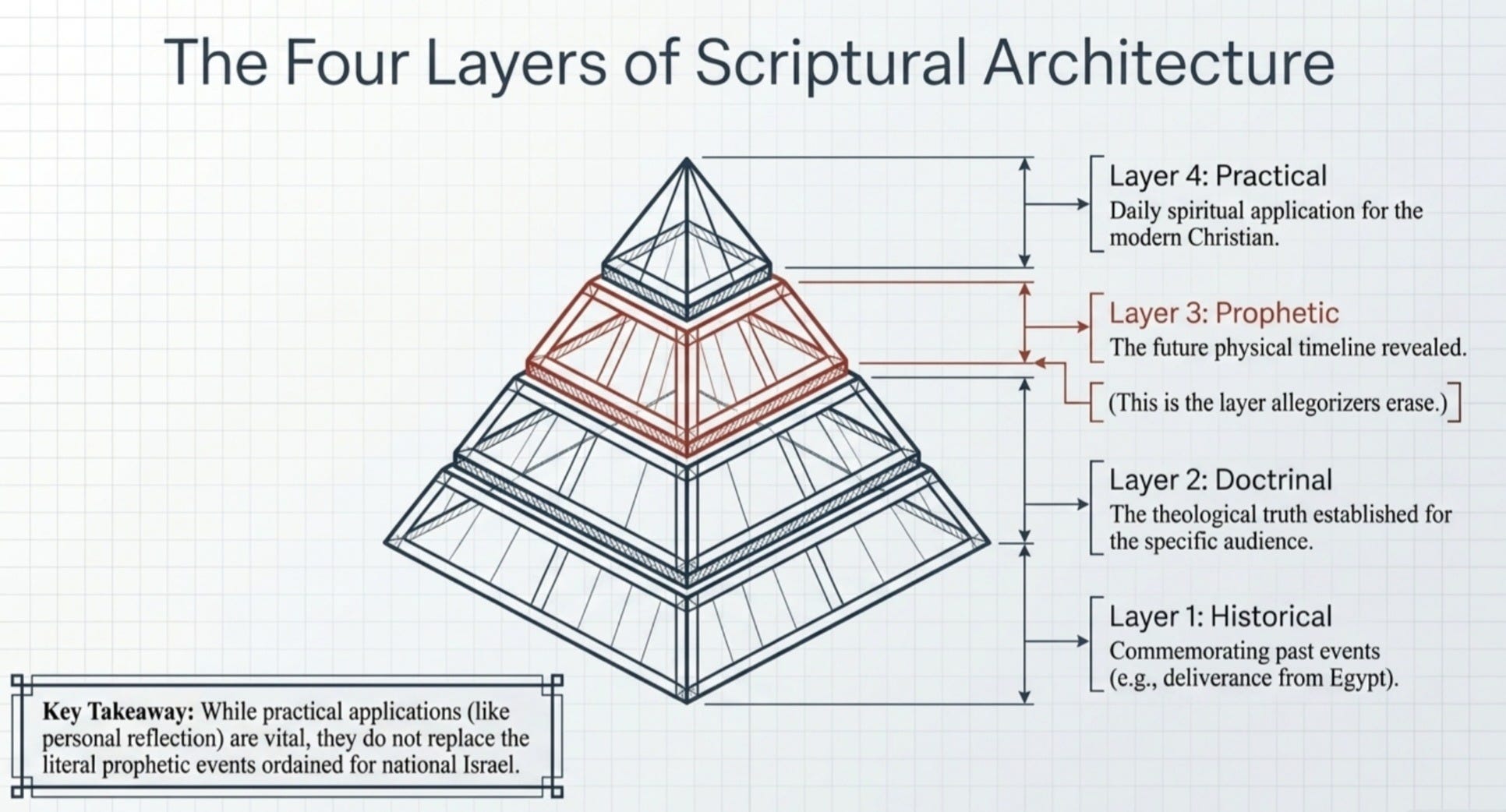
I urge students of the word to approach the Scriptures with a rigorous, rightly divided hermeneutic. A theologically robust study of God’s word requires us to recognize that a biblical text can yield multiple layers of truth. Specifically, to protect the integrity of the text, we must evaluate passages through four distinct lenses: historical, doctrinal, prophetic, and practical.
1. The Historical Lens: The Anchor of Fact
First, we must anchor our study in the historical application. The events recorded in the Bible are factual and rooted in real time, geography, and space. For example, when reading about God commanding Joshua to lead Israel across the Jordan River to conquer Jericho, we must first recognize its historical reality: it was a literal military campaign fought by a physical nation. Similarly, when reading about David slaying Goliath in the Valley of Elah, we are reading about a real boy, a real giant, and a literal stone. We cannot bypass the historical reality of the narrative, or we risk uprooting the text from its reality and turning historical truth into mere mythology.
2. The Doctrinal Lens: The Boundary of Truth
Second, we must identify the doctrinal application. Doctrine establishes our theological framework and necessitates rightly dividing the word of truth to understand exactly to whom a passage is addressed. Teaching practical or transitional events as definitive doctrine for the New Testament Church is incredibly dangerous if the context is clearly meant for Israel under the Law. Doctrinally, we must acknowledge that physical, national commands, such as animal sacrifices at the tabernacle, dietary laws, or marching around a city with trumpets, remain distinct from the spiritual realities of the Body of Christ. You cannot build a Church Age doctrine on a promise or command explicitly given to national Israel.
3. The Prophetic Lens: The Blueprint of Things to Come
Third, we examine the prophetic application. God’s historical and doctrinal dealings often serve as a blueprint for future eschatological events. The physical history of the Old Testament frequently mirrors the prophetic landscape of the future. Consider the historical account of Joseph: he was rejected by his own brethren, cast into a pit, delivered to the Gentiles, and eventually elevated to the throne, where he saved the world and was finally reconciled to his brothers. Prophetically, this perfectly foreshadows the first coming, rejection, resurrection, and future second coming of Jesus Christ to an enlightened Israel. Likewise, the global judgment of Noah’s flood or the physical destruction of Sodom are historical events that Jesus and the apostles explicitly used to picture the prophetic terrors of the coming Day of the Lord.
4. The Practical Lens: The Power of Transformation
Finally, only after establishing these foundations do we make the practical or spiritual application. The dangerous error of the historical allegorizing method—traced back to Alexandria—is to jump straight to a spiritualized meaning, bypass the literal text, and make the reader’s feelings or imagination the final authority. However, when properly ordered, practical application is vital.
For instance, while the historical and doctrinal realities of David defeating Goliath belonged to Israel’s warfare, the Christian can practically draw immense encouragement knowing that the same God who delivered David can deliver us from the spiritual giants of fear, temptation, and trial in our daily walks. Similarly, just as God provided literal manna from heaven to sustain Israel in a physical wilderness, we can practically apply this to trust that our Heavenly Father will faithfully supply all our physical and spiritual needs today.
By strictly maintaining this method, historical, doctrinal, prophetic, and finally practical, we honor God’s literal promises to His historical people while allowing His immutable word to powerfully transform our daily lives.
2 Timothy 2:15 Study to shew thyself approved unto God, a workman that needeth not to be ashamed, rightly dividing the word of truth.
2 Timothy 3:16-17 All scripture is given by inspiration of God, and is profitable for doctrine, for reproof, for correction, for instruction in righteousness: That the man of God may be perfect, throughly furnished unto all good works.