

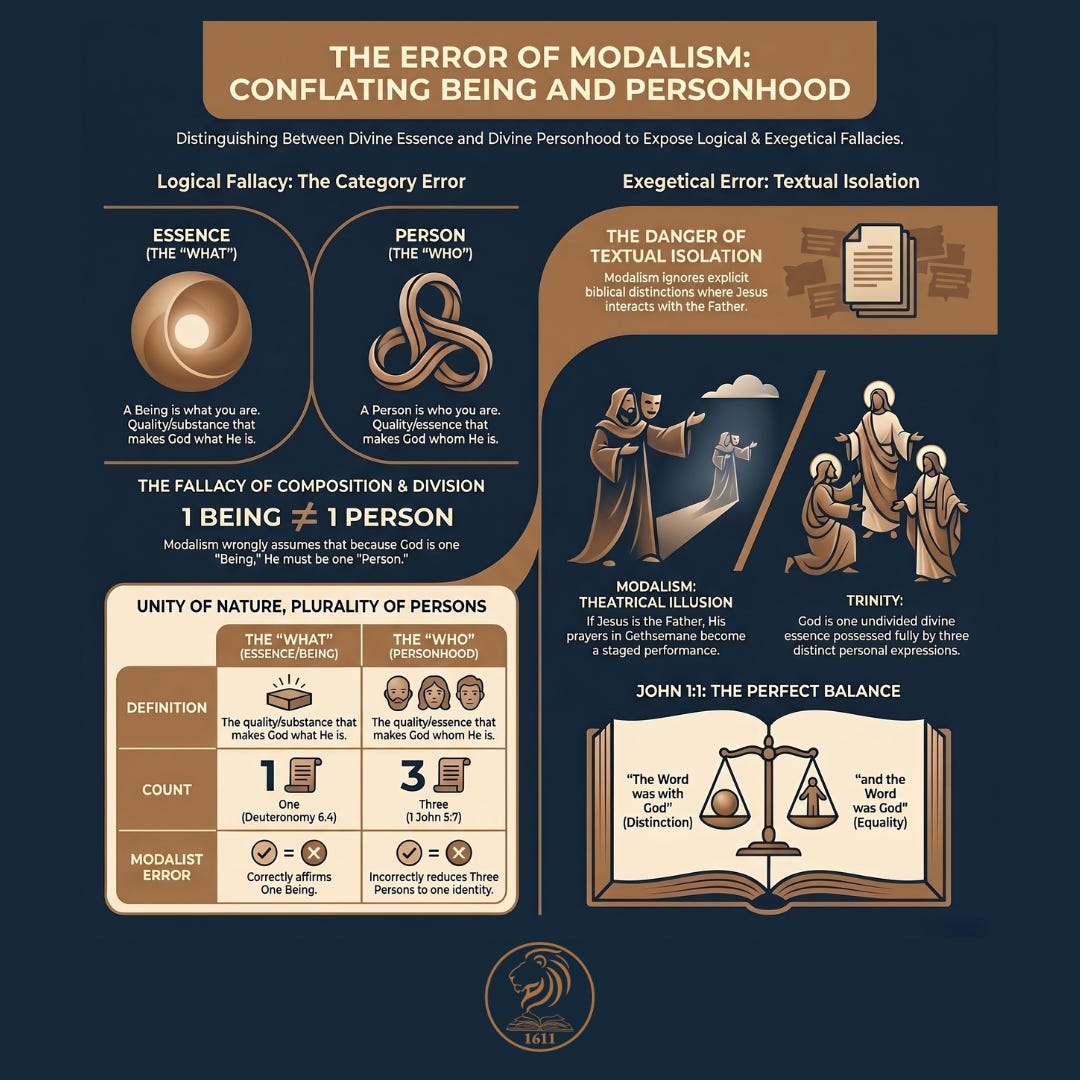
The Challenge:
Confounding the distinct Persons of the Father and the Son through a "Jesus-Only" Modalist framework misinterprets Christ’s statement of essential oneness and unity as a declaration of absolute identity, collapsing the clear scriptural distinctions within the Godhead.
1. The Issue & The Steel Man
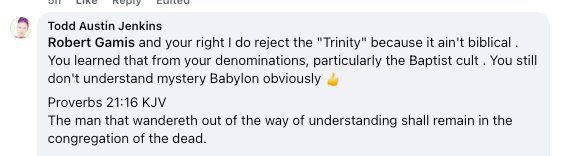
The Objection: The critic argues that the Trinity is a false, denominational invention because scriptures like John 14:9 and Isaiah 9:6 prove that Jesus is the Father Himself in bodily form, and Hebrews 1:3 references a singular “person,” thereby invalidating the concept of three distinct Persons.
The Steel Man: Because God is explicitly declared to be one, and because Jesus states that seeing Him is equivalent to seeing the Father, Jesus Christ must be the singular Person of God occupying different manifestations or roles (Father, Son, and Holy Ghost) rather than one of three distinct co-eternal Persons.
2. Worldview & Logical Analysis
False Assumptions: Presupposes that relational oneness, shared essence, and perfect representation mean absolute personal identity, while assuming that the singular noun “person” in Hebrews 1:3 describes the entire Godhead rather than specifically the Father.
Logical Fallacies: Fallacy of Composition / Cherry-Picking (isolating verses showing Christ’s deity to deny verses showing His distinct relationship to the Father).
Validity & Soundness: The argument is unsound because it cannot harmonize its conclusions with the numerous passages where the Father and the Son act simultaneously as distinct personal agents.
3. The Rebuttal (Logic & Scripture)
Logical Deconstruction: If Jesus is literally the Father, then Christ’s prayers to the Father in John 17 become an exercise in self-delusion or theatrical venting. Saying “he that hath seen me hath seen the Father” denotes that Christ perfectly manifests the character, nature, and visible presence of the invisible Father (Colossians 1:15), not that He is the Father.
Scriptural Authority: * John 8:17-18: “It is also written in your law, that the testimony of two men is true. I am one that bear witness of myself, and the Father that sent me beareth witness of me.” (Jesus explicitly counts Himself and the Father as two distinct witnesses).
Matthew 3:16-17: “And Jesus, when he was baptized, went up straightway out of the water... and lo a voice from heaven, saying, This is my beloved Son, in whom I am well pleased.” (The Son is in the water, the Spirit descends, and the Father speaks from heaven simultaneously).
John 5:22: “For the Father judgeth no man, but hath committed all judgment unto the Son:” (One cannot commit authority to oneself if no personal distinction exists).
4. Tactical Responses & Questions
Robust Responses: “When Jesus said ‘I and my Father are one’ in John 10:30, the scriptural context demonstrates a oneness of essence and purpose, not a oneness of identity, which is why the Jews accused Him of making Himself equal with God, not identical to the Father.” (Equality vs Identity)
Challenging Questions: “If Jesus is the Father, to whom was He speaking on the cross when He cried, ‘Father, into thy hands I commend my spirit’?”
“How do you reconcile your position with John 8:17-18, where Jesus legally establishes that He and the Father constitute two distinct witnesses according to the law?”