


2 Timothy 2:3 Thou therefore endure hardness, as a good soldier of Jesus Christ.
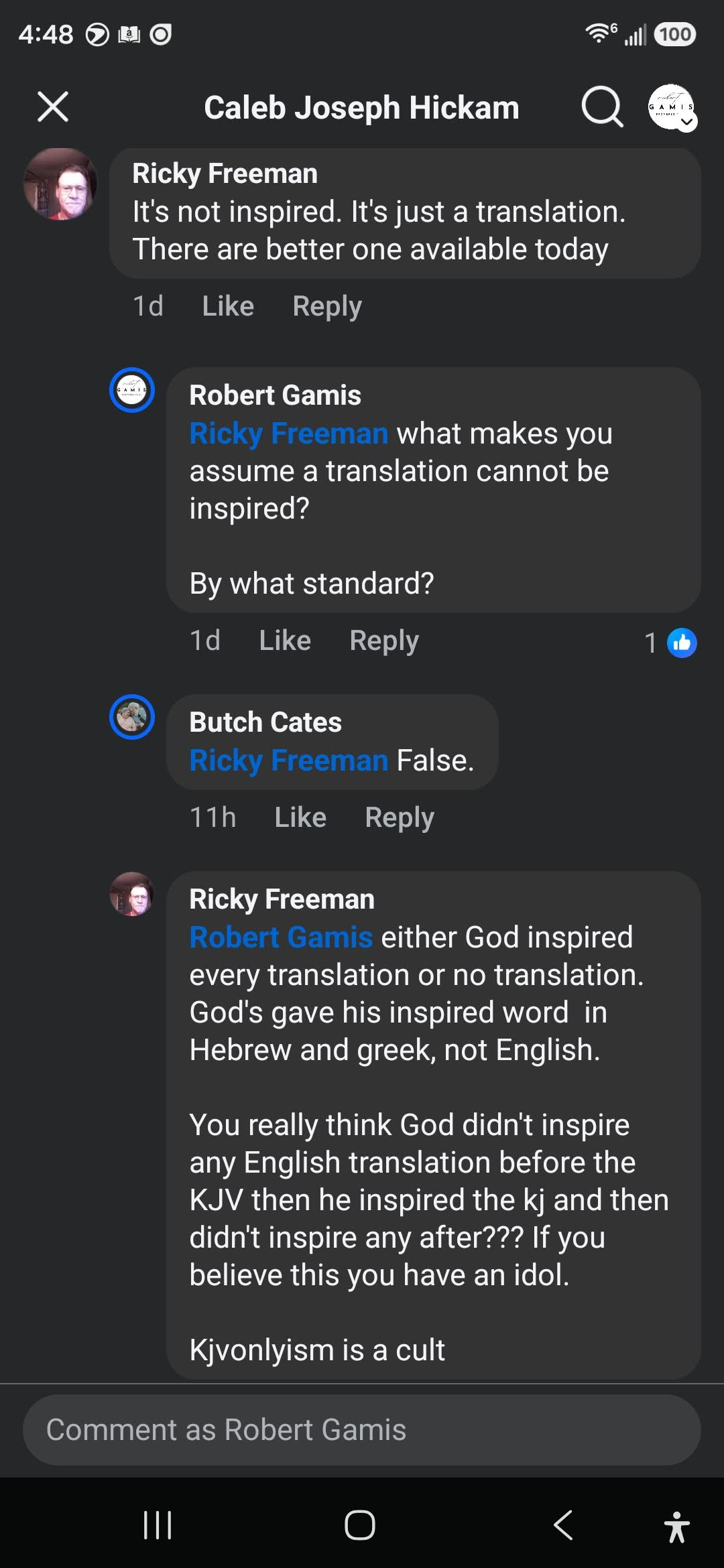
Ricky Freeman argues that no translation can be inspired; therefore, KJV Onlyism is a cult.
Hotwash:
The critic’s claim that translations cannot be inspired ignores the over 600 instances in scripture where God perfectly inspired the translation of one language into another, proving translation is an integral part of His divine preservation.
The After Action:
Inspiration of Translations
1. The Event & The Steel Man
The Objection: Ricky Freeman claims KJV Onlyism is a cult because translations cannot be inspired, insisting God only gave His word in Hebrew and Greek.
The Steel Man: Because human languages do not allow for exact, one-to-one equivalents, any translation inherently requires human interpretation, meaning the resulting text cannot possess the same miraculous, inerrant inspiration as the original Hebrew and Greek autographs.
2. Worldview & Logical Analysis
False Assumptions: The critic assumes “perfect” requires an exact word-for-word match to the original, rather than a perfect-meaning translation overseen by God. They also falsely assume the word “scripture” applies only to original autographs, a concept never found in the Bible.
Logical Fallacies: Reductio ad absurdum error—claiming translations aren’t inspired simply because there isn’t a single verse explicitly stating “I will inspire English translations”.
Validity & Soundness: The argument is invalid and unsound because it contradicts the internal biblical evidence showing God frequently utilizes translation to deliver His inspired word.
3. The Rebuttal (Logic & Scripture)
Logical Deconstruction: If a translation cannot be inspired, then much of the Bible itself is uninspired. The New Testament contains 633 translations from Hebrew to Greek. When Paul spoke Hebrew in Acts 22, Luke recorded it perfectly in Greek under the inspiration of the Holy Ghost. The process of inspiration necessarily includes transcription, transmission, and translation.
Scriptural Authority:
“All scripture is given by inspiration of God...” (2 Timothy 3:16).
“And when they heard that he spake in the Hebrew tongue to them, they kept the more silence: and he saith,” (Acts 22:2) followed by Luke’s perfectly inspired Greek translation of Paul’s Hebrew words.
“And I said, Who art thou, Lord? And he said, I am Jesus whom thou persecutest.” (Acts 26:15) — recorded in Greek by Luke, though Christ spoke to Paul in the “Hebrew tongue” (Acts 26:14).
4. Tactical Responses & Questions
Robust Responses:
God’s preservation requires a Bible today that is practical and accessible; with the originals lost, this is impossible without an inspired translation.
In scripture, “translation” is consistently framed as an elevation, always an improvement over the original.
Challenging Questions:
If no translation can be inspired, do you reject Luke’s Greek translation of Paul’s Hebrew testimony in Acts 22 as uninspired?
Since the word “scripture” occurs 53 times in the KJV and never once refers to an original manuscript, by what biblical standard do you restrict inspiration only to the lost autographs?