

The Replacement Advocate argues that God's promises to Israel in the Old Testament are fulfilled in the Church in the New Testament.
Replacement theology violates God’s immutable character by falsely claiming the Church replaced Israel, ignoring distinct biblical covenants and kingdoms.
Apologetics AAR: Replacement Theology vs. Dispensational Distinction
1. The Event & The Steel Man
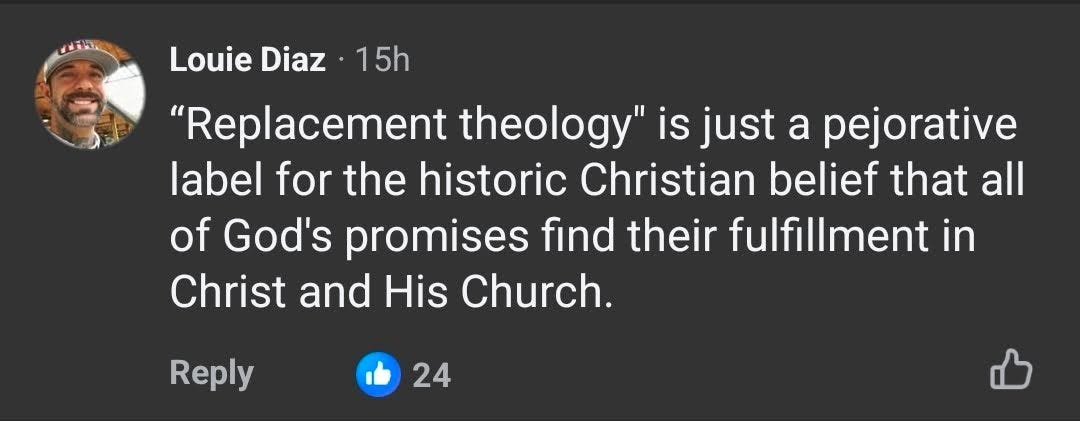
The Objection: “Replacement theology” is merely a pejorative label used against the historic Christian belief that all of God’s promises find their ultimate fulfillment in Christ and His Church.
The Steel Man: Since Christ is the ultimate fulfillment of God’s revelation, all Old Testament promises made to literal Israel are spiritually inherited and fulfilled by the New Testament Church, meaning God has no separate, national future for Israel.
2. Worldview & Logical Analysis
False Assumptions: Presuppose that Israel’s disobedience under a conditional covenant nullified an unconditional covenant, and assume the “Kingdom of God” and the “Kingdom of Heaven” are identical.
Logical Fallacies: Equivocation—confusing the distinct definitions of Israel and the Church; Straw Man—misrepresenting a structural theological error as just a historical definition; and Begging the Question—assuming your conclusion as a premise (which should be your evidence).
Validity & Soundness: Unsound. The argument relies on false premises that strip words of their literal, grammatical, and historical context.
3. The Rebuttal (Logic & Scripture)
Logical Deconstruction: God’s integrity demands that an unconditional covenant remain unconditional. If God breaks His specific national promises to literal Israel, His word cannot be trusted as immutable truth.
Scriptural Authority:
Romans 11:1 — ”I say then, Hath God cast away his people? God forbid. For I also am an Israelite, of the seed of Abraham, of the tribe of Benjamin.”
Romans 11:29 — ”For the gifts and calling of God are without repentance.”
Galatians 3:17 — ”And this I say, that the covenant, that was confirmed before of God in Christ, the law, which was four hundred and thirty years after, cannot disannul, that it should make the promise of none effect.”
The unconditional covenant to Abraham cannot be annulled by the conditional covenant to Moses (430 years later), despite Israel’s failure to obey it.
Galatians 3:28 — "There is neither Jew nor Greek, there is neither bond nor free, there is neither male nor female: for ye are all one in Christ Jesus.”
This verse refers to unity in Christ and does not imply that Israel as a nation is dissolved or irrelevant. It also does not erase the ethnic or national distinctions of Israel any more than it negates biological differences between men and women.
4. Tactical Responses & Questions
Robust Responses:
“God’s fulfillment of promises in Christ does not give the Church the right to identity-theft Israel’s specific national and earthly inheritance.”
“If God can break His unconditional promises to Israel because of their unfaithfulness, then your eternal security in Christ is also up for negotiation.”
Challenging Questions:
“If the Church replaced Israel, why does the New Testament explicitly maintain a distinction between Jews, Gentiles, and the Church of God in 1 Corinthians 10:32?”
“If Galatians 3:28 is proof that Israel and the Church are no longer distinct, is it also true that there are no distinctions between men and women?”
“When God swore an oath to Abraham in Genesis 15 while Abraham slept, making the covenant entirely unconditional, exactly what verse shows God changing His mind and breaking that oath?”