The Living Cornerstone
A Logical and Scriptural Defense of the Bodily Resurrection

The Obligation to Truth
The Bible calls believers to be faithful stewards of the truth (1 Cor. 4:2; 2 Cor. 4:1-2) and emphasizes our duty to defend and uphold the faith (1 Thess. 5:21; 2 Pet. 3:15; Jude 3). Therefore, understanding the cornerstone of our Christian faith, the bodily resurrection of Jesus Christ, is crucial. Christianity is not a blind leap in the dark; it is a logical step into the light, rooted entirely in the historical, physical resurrection of Jesus. Without the literal triumph over the grave, our faith is empty. But because He lives, we have a hope supported by “many infallible proofs” (Acts 1:3).
I. The Indispensable Cornerstone of Christianity
The bodily resurrection is the absolute cornerstone of Christianity. Without it, there is no Christianity to speak of. If Jesus Christ had merely died on the cross and remained in the tomb, His death would be viewed historically as the heroic end of a misguided martyr, the pathetic demise of a deranged madman, or the rightful execution of a fraud. The resurrection is what transforms the crucifixion from a tragic Roman execution into a triumphant, atoning sacrifice for the sins of the world. It is God the Father’s divine “amen” to the Son’s substitutionary blood atonement, proving its absolute sufficiency to defeat death, the Devil, sin, and the grave.
No other world religion requires a resurrection to validate its truth claims. If archaeologists were to discover the entombed remains of Muhammad, a Muslim could still follow the Quran; if they found the bones of Buddha, a Buddhist could still seek enlightenment; if they uncovered the ashes of a Hindu deity, Hinduism would continue unabated. However, if you were to find the body of Jesus Christ, you could not be a Christian. Christianity alone is built upon an empty tomb. As the Apostle Peter declared, we have been begotten “again unto a lively hope by the resurrection of Jesus Christ from the dead”.
II. The Logical Reductio Ad Absurdum of 1 Corinthians 15
The Apostle Paul, inspired by the Holy Ghost, employs a masterful logical argument in 1 Corinthians 15 to defend this cornerstone. Facing a heresy in the Corinthian church that denied the bodily resurrection of believers, Paul utilizes a classic logical construct known as reductio ad absurdum (reducing an argument to absurdity). He argues from the reverse: What if the skeptics are right? What if there is no resurrection of the dead?
Paul demonstrates that if we accept the premise that the dead rise not, the logical consequences absolutely destroy the entire Christian faith.
Christ is not risen: If dead men do not rise, then Jesus Christ, who partook of flesh and blood, is still in the grave.
Our preaching is vain: If Christ is dead, there is no gospel. All of our apostolic preaching is pointless, empty blabber because we are preaching a dead savior who cannot save.
Your faith is vain: Every believer sitting in a church is wasting their time, reaching out to a God who isn’t there, and believing in a lie.
We are false witnesses: The Apostles, who claimed to have seen the risen Lord, are exposed as frauds, impostors, and liars.
Ye are yet in your sins: Because it was our sin that nailed Christ to the cross, if He did not resurrect, then sin and death won the victory.
The dead have perished: Those who have fallen asleep in Christ are eternally lost.
Paul reduces the skeptic’s argument to utter despair before delivering the triumphant conclusion: “But now is Christ risen from the dead” (1 Corinthians 15:20). Because the resurrection is an empirical fact, it proves that truth is stronger than lies, good is stronger than evil, and love is stronger than hate.
III. The Internal Consistency of the Timeline and the “Good Friday” Error
One of the greatest testimonies to the perfection of the King James Bible is the flawless mathematical and historical consistency of the passion week timeline. Yet, a vast majority of Christendom holds to the unbiblical “Good Friday” myth, which is logically and mathematically impossible.
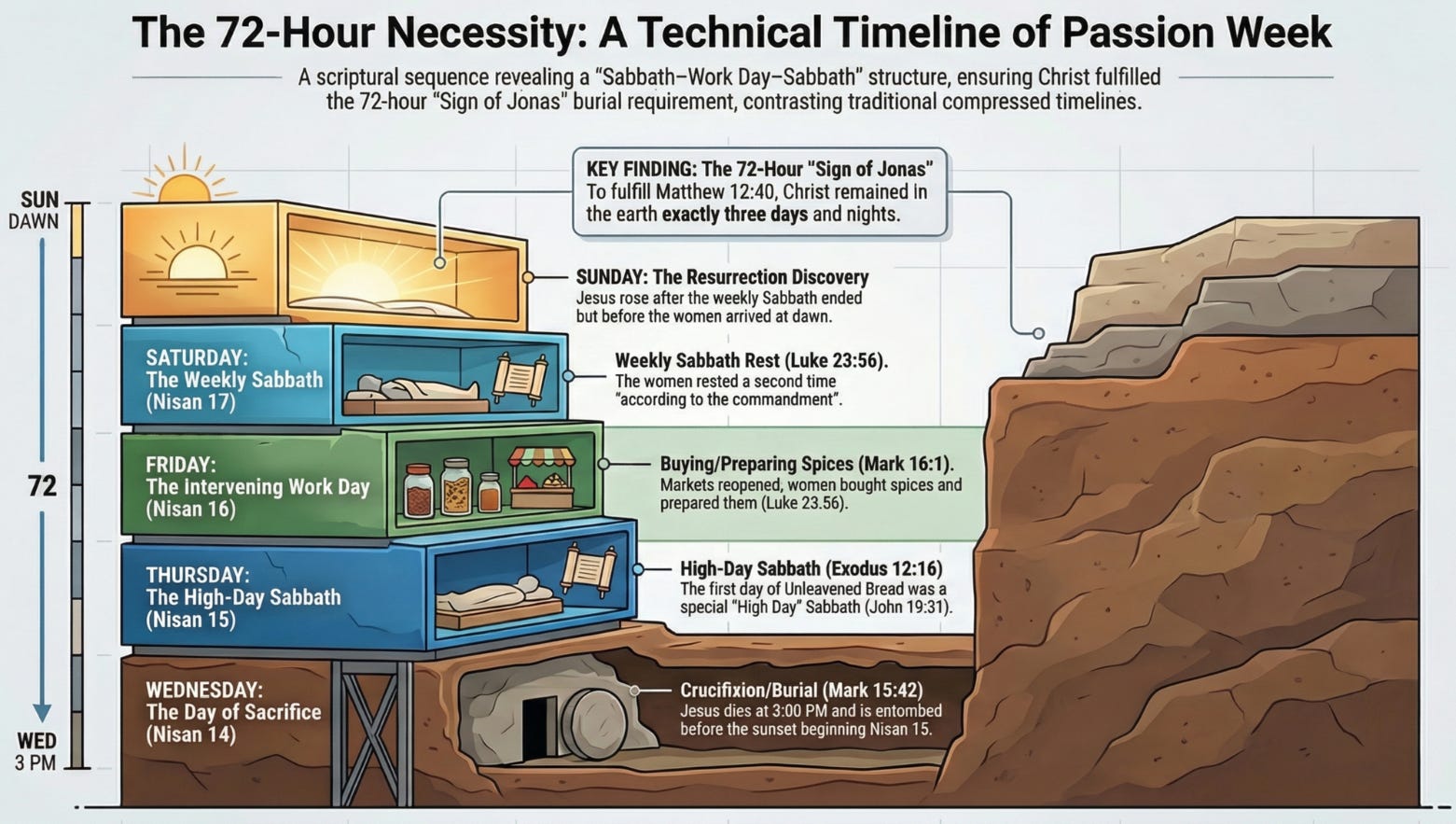
During His earthly ministry, Christ offered only one definitive sign to an evil and adulterous generation: the sign of the prophet Jonas. He prophesied, “For as Jonas was three days and three nights in the whale’s belly; so shall the Son of man be three days and three nights in the heart of the earth” (Matthew 12:40).
A Friday evening burial and a Sunday morning resurrection yield a maximum of barely 36 hours. You cannot squeeze three days and three nights out of a Friday crucifixion without violently twisting the Scriptures. To satisfy the divine mandate of a full 72 hours, the word of God demands a Wednesday crucifixion.
The confusion stems from a failure to recognize that there were two Sabbaths during the crucifixion week, not one.
Wednesday (14th of Nisan): Christ, our Passover lamb, was crucified at the third hour (9:00 AM) and died at the ninth hour (3:00 PM). Because a Sabbath was rapidly approaching at sundown, He was hastily buried.
Thursday (15th of Nisan) - The High Day Sabbath: This was not the weekly Sabbath on Saturday. This was the first day of the Feast of Unleavened Bread, a special “high day” Sabbath of rest (Exodus 12:15-16; John 19:31). No work could be done.
Friday (16th of Nisan) - The Work Day: The markets reopened. Friday was a normal workday sandwiched between two Sabbaths.
Saturday (17th of Nisan) - The Weekly Sabbath: This was the regular seventh-day Sabbath.
The internal biblical proof for this is found in a supposed “contradiction” regarding the women and their burial spices. Mark 16:1 states that “when the sabbath was past,” the women “bought sweet spices.” Yet, Luke 23:56 states that the women “prepared spices and ointments; and rested the sabbath day.”
How can they buy spices after the Sabbath, yet prepare them and rest on the Sabbath? The answer unlocks the perfect chronology: They waited for the Thursday High-Day Sabbath to pass. On Friday morning, they went to the open markets to buy the spices. They spent Friday preparing the spices. Then, they rested on the regular Saturday weekly Sabbath. Only a Wednesday crucifixion with a “Sabbath + Work Day + Sabbath” scenario fits the text. The King James Bible is vindicated, and the Good Friday tradition of men is demolished. By Saturday evening at sunset, exactly 72 hours had passed, and Christ rose from the dead.
IV. Logical Rebuttals to Typical Objections
Skeptics and infidels have spent two millennia attempting to explain away the empty tomb. As logicians and apologists, we must recognize that their alternative theories buckle under the weight of internal biblical consistency and common sense.
1. The Swoon Theory This theory posits that Jesus merely fainted on the cross from weakness and later revived in the cool, damp tomb. Medically and logically, this is preposterous. Prior to crucifixion, Jesus was scourged to within an inch of His life, and His side was pierced with a Roman spear to confirm His death. Furthermore, Nicodemus wrapped the body with 100 pounds of embalming spices, such as myrrh and aloes, which were poisonous and would have suffocated a weakened man. It is highly irrational to suggest a half-dead, severely mutilated man could unwrap His own tight mummy-like grave clothes, push away a massive stone from the inside, overpower a squad of heavily armed Roman guards, and then present Himself to His disciples as the glorious Conqueror of Death.
2. The Theft Theory The very first lie propagated against the resurrection was concocted by the Jewish Sanhedrin, who bribed the terrified Roman guards to say: “His disciples came by night, and stole him away while we slept” (Matthew 28:13). The logical absurdity of this claim is self-evident: how could sleeping guards possibly know who stole the body? Furthermore, the disciples were cowards who had fled at Christ’s arrest; Peter even cowered before a young maiden. They lacked the courage and martial prowess to overcome a trained Roman watch.
Additionally, if this were a hasty grave robbery, why would the thieves take the time to meticulously unwrap the body and leave the linen grave clothes lying perfectly in place, with the head napkin wrapped together in a place by itself (John 20:6-7)? The very necessity of the Sanhedrin fabricating this exaggerated story is profound historical evidence that the tomb was undeniably empty.
3. The Hallucination Theory Modern critics claim the disciples experienced grief-induced hallucinations of the risen Christ. However, psychological hallucinations are highly individualized, internal events, like a dream. There are no historical or psychological precedents for large groups of people having the exact same sustained, detailed, multi-sensory hallucination. Yet, the risen Christ appeared to over 500 brethren at once (1 Corinthians 15:6), the majority of whom were still alive to corroborate the claim when Paul penned his epistle.
Furthermore, the disciples were not expecting a resurrection; they were steeped in grief, unbelief, and skepticism. Thomas outright refused to believe until he physically touched the wounds. A hallucination simply cannot be touched. Finally, a hallucination does not explain the missing corpse. The authorities needed only to walk down the street to the tomb and produce the rotting body of Jesus to shatter the infant church, yet they could not.
V. Conclusion
The ultimate empirical evidence of the resurrection’s reality is the Apostles’ radical transformation. Following the crucifixion, they were scattered in fear and despair. Within days, they were transformed into bold proclaimers of the Gospel who willingly endured persecution, torture, and martyrdom. While deluded men may occasionally die for a lie they falsely believe to be true, it is a psychological impossibility for multiple men to willingly suffer a brutal death for something they know to be a fabricated lie. If they had stolen the body, they would have known the resurrection was a hoax. If money, sex, or power were their motives, they failed miserably.
We do not worship a dead martyr; we serve a living Saviour. He provided infallible proofs of a physical, “flesh and bones” resurrection (Luke 24:39). While the historical, chronological, and logical evidences defending the empty tomb are insurmountable, the greatest evidence a believer possesses is the internal relationship with the living Christ. This salvation, this kinship, and this welcoming into the family of God would not be possible with a dead savior. I know He is living because He is living in me. The King James Bible perfectly preserves the record of this world-altering event, assuring us that the bodily resurrection is not a myth or a theological metaphor, but a settled historical and divine fact.
"I know of no one fact in the history of mankind which is proved by better and fuller evidence of every sort, to the understanding of a fair inquirer, than the great sign which God hath given us that Christ died and rose again from the dead." Thomas Arnold (Former Chair of Modern History at Oxford)
"If Jesus was raised from the dead, then He is Lord, and Christianity is true. If he were not, then Christianity is false. The resurrection is the central point." Gary Habermas (Historian and Philosopher)
[Luk 24:5 KJV] “And as they were afraid, and bowed down their faces to the earth, they said unto them, Why seek ye the living among the dead?”