What Doth Your Arguing Reprove?
What is an argument?


Job 6:25
How forcible are right words! but what doth your arguing reprove?
Have you ever noticed that just throwing facts at someone rarely changes their mind? Instead of persuasion, you usually just get pushback, excuses, and heated rhetoric.
First, let’s clear up a major myth about what an argument is not. It is not an emotional shouting match, a quarrel, or simply dumping isolated data points onto an opponent. When you push facts without a logical framework, people simply filter them through their biases and dismiss your evidence as hostile propaganda.
So, what exactly is an argument? It is a sequence of statements moving logically from evidence to a necessary verdict. Think of a well-constructed argument as a sturdy bridge crossing a river.
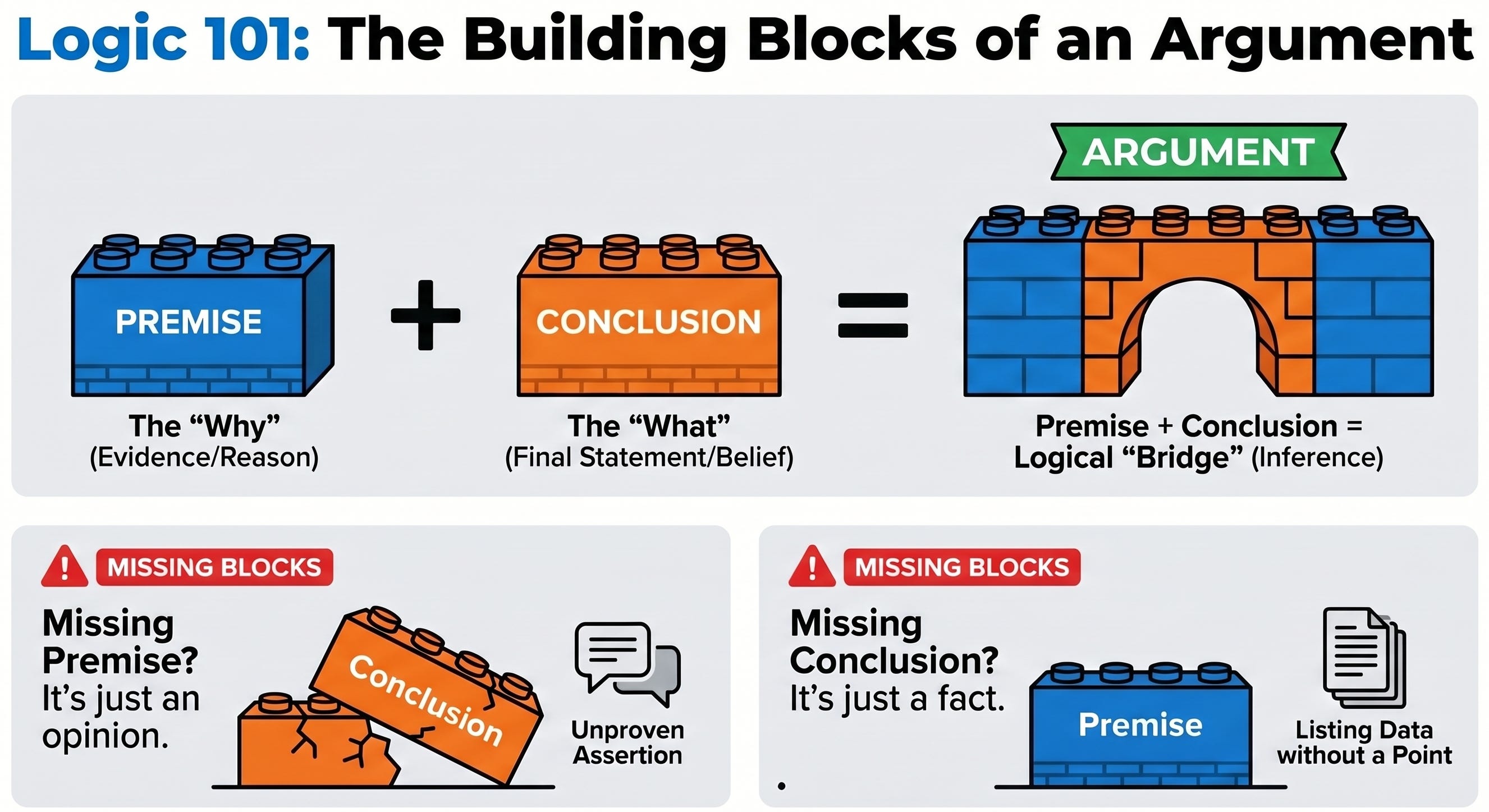
Every solid argument requires four structural parts:
The Premises: This is the solid ground you start from. They are the established facts, data, and evidence supporting your case.
The Conclusion: This is your destination on the other side of the river. It is the final verdict or claim you want someone to believe.
The Inference: This is the mental action of crossing the bridge. It is the logical movement—the “therefore”—that securely connects your starting facts to your destination.
The Hidden Assumption: These are the invisible pillars underwater holding the bridge up. They are the unstated rules and beliefs that make the whole argument work.
Why should Christians care about building these mental bridges? Because we are engaged in a spiritual war of ideas, and false ideas lead people to make disastrous choices. We are explicitly commanded to tear down mental strongholds and give a reasoned defense for our hope. (2 Cor. 10:4-5; 1 Peter 3:15)
Jesus Christ and the Apostle Paul were master logicians who used well-constructed arguments to expose errors and teach objective truth. Mastering real arguments allows you to dismantle secular frameworks by exposing their weak, hidden assumptions. You cannot truly love God with all your mind if you simply turn your brain off.
If you are constantly frustrated that nobody accepts your facts, ask yourself this: What unstated assumptions are you relying on to build your case, and are you willing to subject your own hidden beliefs to the same rigorous interrogation that you demand of others?